While there is much of Bali I haven’t seen, I have visited over 10 times now and I am often asked about traveling there from friends and family who are looking to go there for the first time. Interestingly, there are still many people who are hesitant to travel there given the history of Bali and also the ‘stories’ painted by media and those who have had negative experiences, tend to get the air time more than those who, like me, love the place. So here is a comprehensive and practical guide to what you might need to know if traveling for the first time. Noting the majority of my travel there I have stayed around the Legian and Seminyak areas.
Flights and Accommodation
Many flights to and from Bali will have you arriving, or leaving there in the night time. If you can get on a good deal – take it. Just remember if it is your first time, you may find yourself shopping more than you think, so consider making sure you have the option for extra baggage for your way home.
Booking with a travel agent or doing it yourself doesn’t make all that much difference. Since COVID there are a lot of flexibility in booking if there is a reason you can no longer travel.
When it comes to accommodation, the choices are endless and meet anyone’s budgets. I know this goes without saying, but read reviews, join Facebook groups like Bali Bogans and Bali Tourist Information for lots of regular Bali traveler’s hints and tips. You will quickly work out there everyone has a favourite spot to share.
Hotels and villas are both popular for different reasons. Families sometimes enjoy the hotel vibe, which gives kids the opportunity to hang out at the hotel pool and socialise with other kids traveling. Villas are a great option if you’re looking for more solitude, or your own private pool to jump into after long walks around the streets. AirBNB and Flipkey are the 2 sites I book with when it comes to villas, and Hotels.com for hotels (mostly as they have a ‘rewards card’ system where you end up scoring a free night, averaged out, after 10 are booked through their website – so I use this for all my hotel bookings regardless of where in the world it is). Given the humid climate it is my view that air conditioning is essential, even if you plan to spend most of your days out and about exploring, as sleeping at night in the humidity can be challenging, unless of course you love the feeling of sweating at night (and not for the fun reasons).
Noting most hotels and villas will either include airport transfers or arrange them for you. This can be helpful particularly when booking villas as they can be located down alleyways and finding the right location isn’t always simple, especially after dark when you’ve arrived from your flight, you’re hot and sweaty from outside the airport and just want to get to your accommodation.
You can of course also hire your own scooter while you are there too, for getting around for about $5/day, however be aware the traffic system there is pretty hectic, and also if you are not a motorcycle licence holder in Australia, and you are in an accident or are injured, your travel insurance will not cover you. So tread with caution.
Transport
Firstly – don’t hire a car! I can’t tell you how many people have asked me this question. I know many people travel the world and want their own set of wheels, but getting around many of the one way streets, parking and the inexpensive costs and availability of taxis, scooters and drivers is endless, so it’s simply just not worth the hassle. Anyone who has been to Bali will claim they have ‘a driver who is the best’. So while I have my own recommendations for that too, I would liaise with them via WhatsApp to see how well they communicate to know if you have someone who’s English is good (which is important if you are wanting to negotiate places to visit and explore for a day). On that note WhatsApp is used very broadly in Bali, so it’s not uncommon to use this as a form of communication with drivers etc, but also many may use Messenger.
The average cost to get from Denpasar Airport to Legian/Seminyak/Kuta shouldn’t really cost you more than $25-30 Australian, and feel free to negotiate prices, even on WhatsApp, that is very commonplace and not a problem to do at all. Given the recent pandemic, I would love to recommend you tip the driver, but this is not expected, simply a suggestion from someone who loves the Balinese.
If you decide to hire a driver for a day trip to either go up to Ubud, head to Bali Zoo, go to Bali Swing, temples or really any day out for more than 4-5 hours you can probably get a driver for about AU$50-$60 in total, which the driver will likely come with a van which should seat up to about 6-8 people.
Taxis/Scooters and day to day short transport I will cover later.
Navigating the airport
There will be lines……it will be hot in places…..be prepared as the system there is now somewhat different due to the pandemic as you have to currently have your vaccination certificate checked, you need to pay for a Visa on Arrival (VOA) – for participating countries, go through passport control, and then your customs declaration (which is now available online and can be completed no more than 3 days before travel, which you scan a QR code right as your last step). Be patient and polite, the Balinese will do it in their time, but you will eventually get to the end.
There is a ‘fast pass’ type option called a VIP airport service, which allows you to skip the queues and you pay around AU$50/person. A host will meet you at the arrival gate and take you through all the necessary check points a bit faster. Many of the companies can also include an airport transfer if you haven’t had this arranged by your accommodation. The various Facebook groups mentioned above will help you locate ones that are reputable and been used by previous travellers. Personally the longest and most established service of this kind is TIC Bali, but there are a number of them, so have a look and go with one you’re comfortable with.
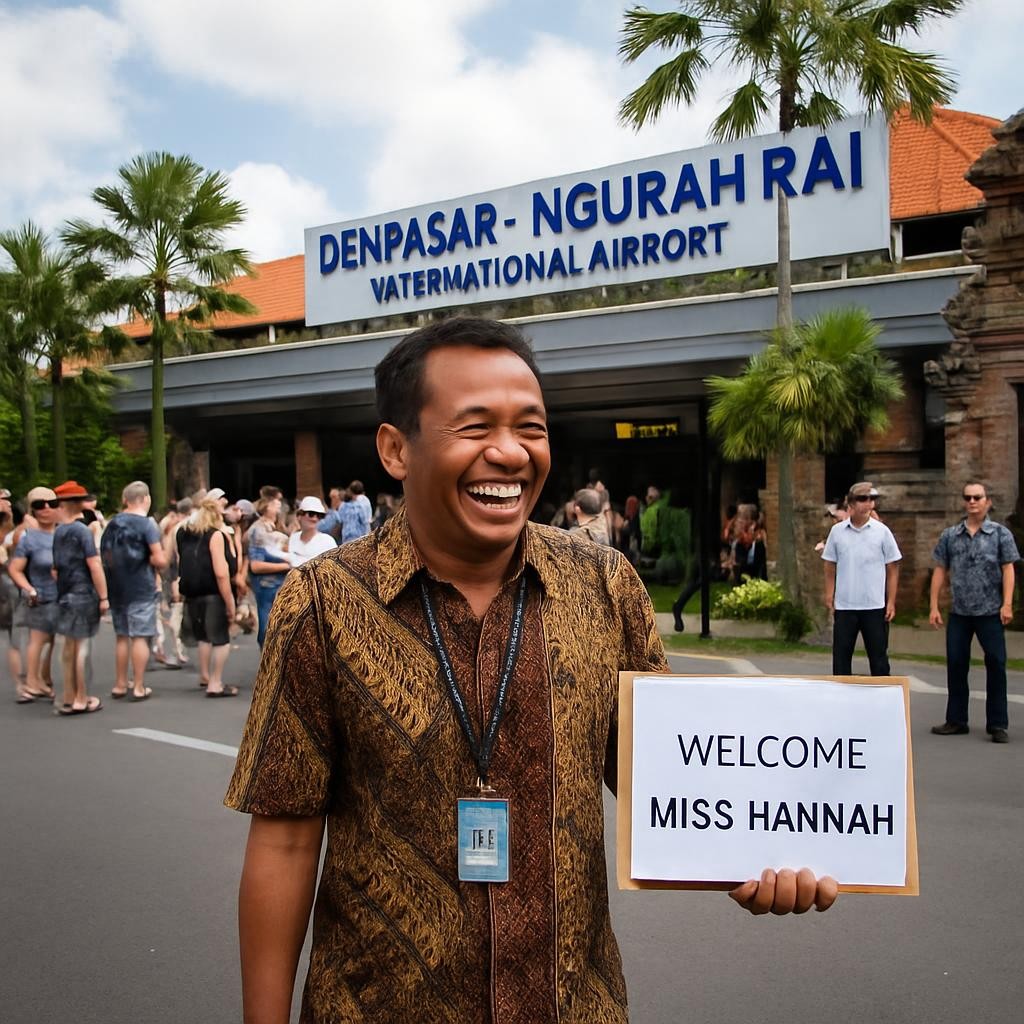
As soon as you are through the QR code, you will enter the arrivals hall where you will immediately be asked if you need transport, or wish to shop or need something they are selling, but just wind your way through the area where all the drivers are waiting. There will be masses of people waiting with signs which you will need to navigate through to locate the one that holds your name.
Don’t panic, they will be there, and probably have already been waiting for you for hours before you’ve made your way to that point. If you can’t find them, calling out your name (or the name of the booking) often helps too. Don’t feel silly doing this, there are a lot of people there, all wanting to connect with their passengers. If all else fails, you just head to the administration desk directly outside the exit doors and they can make an announcement for the name of the villa/hotel and booking name to bring your driver out of the woodwork.
Some of the private drivers may want to snap a picture with you for their Instagram or Facebook to help promote their business, or to notify the hotel they’ve located the guests. I am always happy to oblige, and just something to be aware of.
Currency
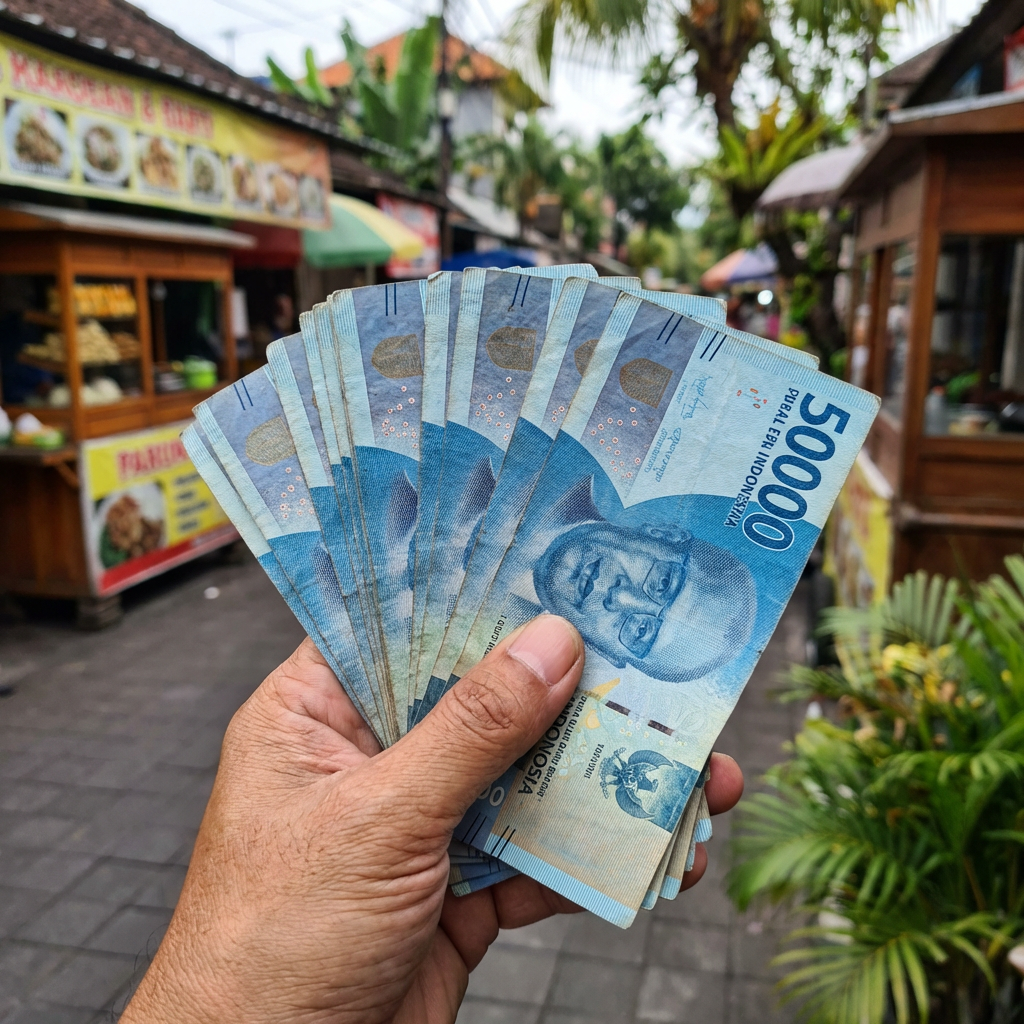
The currency is Indonesian Rupiah and it has a LOT of zeros. While the exchange rate may fluctuate daily, it is always around about the same.
AU$1 = 10000Rp
AU$5 = 50000Rp
AU$10 = 100000Rp
AU$100 = 1000000Rp
You do feel like a millionaire, but at the end of each daily adventure out I always reorganise my cash in order of value, just to make it easier when you need to make purchases, and also not have the need to fumble and flash a lot of cash around in open settings. A small amount to us is a lot to them, so it’s just a smart suggestion for whenever you travel, but there will always be eyes on what money you have. It’s not dangerous, just astute to be cautious.
Depending on where you go EFTPOS is not widely used, so cash is always your best option. You rarely use bank transfer for day trips, transport etc, and always pay when you are at the end. Everyone’s budget is different, but I tend to travel with the equivalent of about AU$600 on arrival and use reputable ATMs to withdraw money while I am there. I would highly recommend not using a money exchange shop front.
Banks obviously have sometimes exorbitant charges for overseas withdrawals etc, so personally I always use ING who refund you any ATM fees charged on the withdrawals and it’s exchange rate is normally pretty good too.
Shopkeepers, hawkers and street shopping
The fun of Bali is in the negotiating. There are a few fixed price shops, however it would be advisable not to ever pay the first price you are given. It is not uncommon when you ask them ‘how much’ they might respond with ‘how many do you want’, they are the kings of the upsell. I have always gone fairly low in starting but have learnt if you walk away from the purchase and they don’t follow you down the street you’ve probably gone too low.
You will be greeted at every shop with ‘yes boss’ or ‘come look’ or ‘you want massage’ and a polite, no thank you (or tidak terima kasih) is the right response. If you’re not comfortable with regular interactions consistently, then perhaps this is not the place for you. It’s just part of the way they work there. They will try many things to get your attention too, like repeating words from the conversation you’re having, using Aussie slang or being a bit cheeky. Don’t be offended, and just continue walking by, or have a bit of fun with them. They are very responsive and love Australians.
You may experience this when you hit the beach bars too for sunset drinks on the sand. There are many people selling all kinds of things. They may linger even if you say no, but eventually they will move on, and most likely will happen more intensively as you first sit down as you’re new to them. Like seagulls to a chip. There will still be different people passing throughout the night, but it will teeter off. You have to remember you’re in a third world country and to them, you’re a millionaire. They are just trying to make a living in the only way they’ve ever know.
One other thing you will definitely experience is being approached on the street as men on their bikes will just stop beside you offer you all kinds of things, valium, dexes, sunglasses, snake oil, DVDs, which then may also turn into ‘transport’ or something else. Again this is common and approach with the same response, and patience. You may even find restaurants permit them to enter their premises to make they way around the tables. Everyone just accepts this as a way of life there.
Day to day getting around
There are countless ways to get around for short trips, and no shortage of options depending on who you’re traveling with and what you are comfortable with. Personally I love getting on bikes as the one way street rules don’t seem to apply to bikes. There are 2 apps most commonly used GoJek and Grab , which you will find shouldn’t cost you more than 10000-20000Rp (AU$1-2) per trip, or if in a taxi 20000-30000Rp depending on how far you are going. A good tip is both these apps double as a food delivery app like Uber Eats and Menulog. So if you fancy a satay chicken poolside at your villa, it can happen quickly and easily.
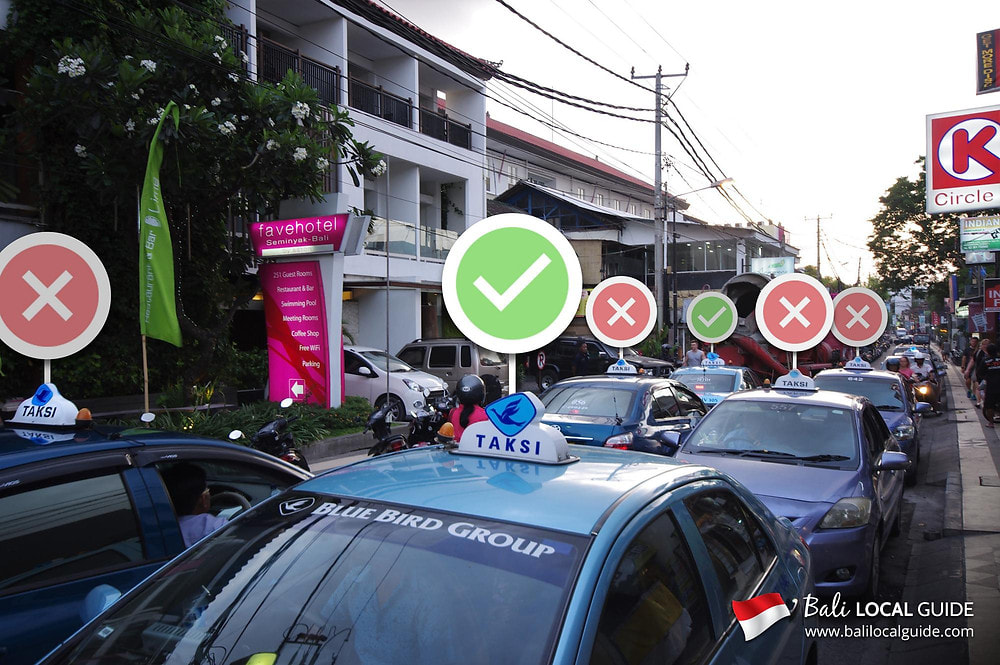
If you are wanting to hail taxis from the street. it’s easy to think they are all the same, however they are not. There is one reputable company called BlueBird who have accurate meters and will not be overcharged or taken advantage of. The taxis will all LOOK like BlueBirds, but as they get closer you will see they will actually be called something like ‘BlueBiro’ or equivalent. The easiest way to spot the right one is the BlueBird logo on the top of the taxi is very large in comparison to the others. As they get closer you will be able to more clearly see the writing in the side door too.
Image below from Bali Local Guide shows it best.
Walking around places like Kuta, Seminyak and Legian is very common so keep your wits about you. Before you step off the kerb look down for deep drains and look both ways for traffic. Even though the streets are one way, bikes disregard this and came come from either direction.
Eating out and menus
Please, for the love of god, try the Indonesian options. The Balinese have done a brilliant job in offering western cuisine or familiar cuisines for Aussies, but the fun of travel is trying new food isn’t it? Well it has always been for me. I tend to be happy to hail down the traveling food trucks (well…….bikes) and try the delicious treats that the locals are eating. My personal favourite is Nasi Campur, which is available on most restaurants menus. Your taste buds won’t be disappointed.
There are many reports about Bali belly from food or having ice in drinks etc, however I have not experienced this personally. But of course it’s up to you what you’re comfortable doing. I’ve always had my GastroStop in my luggage just in case, but I have never needed it. Perhaps its my cast iron stomach, but either way do whatever works for you.
Taxes at restaurants are something to keep an eye out for as some will advertise the price with “++” next to it, which essentially are 2 taxes which are added on top of the cost equating to about 21% on top. So don’t order your Nasi Goreng and leave your 30000Rp with your friend thinking you’ve covered your portion.
However, if you’re traveling with a group or just want to pay separately, the Balinese are great at being accommodating to split bills, but do this at the beginning. Just ask as you’re ordering for separate bills, and they will allocate you with a bill number so each time you order they will add it to yours. Bill number 1, bill number 2….etc. i think the most I’ve experienced when traveling is 8 bills. So much easier than trying to work out the cost and taxes at the end, and obviously easier for them too.
Cocktails and Bintang are often the common options, as you will find a glass of wine with dinner (or lunch) are not quite the standard you may find in Australia. If they are up to standard you will be pay a tidy sum for it. Often more than what you’d pay in an Aussie bar/pub. The best part is though, they don’t judge you for ordering an Espresso Martini or a shot of vodka with breakfast.
Culture and considerations
The Indonesians are a very spiritual race. They have many ‘ceremony’ where traditional dress is worn and often will return to their home village to participate in processions and feasting together. If you have day trips booked or somewhere you need to be in a certain time, it’s worth seeing if you can find out if it is a ‘ceremony’ day as these processions can be long and time consuming and are often held in streets where cars would normally be. It is an incredible spectacle to witness, so if you do end up stuck in a laneway waiting for people to pass by, take it all in. It’s colourful with all walks of life involved.
Another thing you will notice is multiple times a day will give offerings to the gods either at the entrance to their business, the entry to your villa, the dashboard of their taxi, even at the back of a charter boat. This happens so frequently you will find many bamboo leave boxes with offerings of food, or flowers, on the ground so watch your step. It is not disrespectful if you accidently find your foot through one, but obviously don’t go out of your way to kick or remove them.
There is also a significant day in the calendar in March where you will find it to be a bit like Christmas Day here in Australia, in terms of everything shutting down for a day. This is call Nyepi (Day of Silence). The date will change each year so it is worthwhile checking this out before you book, in case this affects your travel dates. Many restaurants in hotels will likely stay open, but others will remain closed, as will shops, bars and supermarkets.
There are all manner of wonderful Indonesian temples and culture to get amongst there, so embrace it. The Balinese people, in my personal opinion, have the best smile in the world, and would give you the shirt off their back if you needed it. For a country that has little, they are willing to give you everything you have.
They also are very respectful of their elders, so if you are a multigenerational family traveling together, don’t be surprised if they want to take extra care of the oldest family member. It is something that has always been so endearing to me when visiting there.
My last tip is to learn some of the language, as with any non-English speaking country, the locals love it when their native tongue is attempted. The language spoken in Indonesia is Bahasa, however there is also some Balinese ‘slang’ words you can use to impress too. My personal Balinese favourite is “sing ken ken” which means “no problem”, and the Balinese version of thank you is Suksema (pronounced sook-sa-ma). The most common way you’ll hear people say thank you is terima kasih, of which they will respond with sama sama (you’re welcome).
They have 4 greetings in a day so I am always checking my clock to see which is appropriate to use:
- Selamat Pagi – Good morning
- Selamat Sian – Good afternoon (from midday)
- Selamat Soiree – Good afternoon (from around 4pm)
- Selamat Malam – Good evening
While I would love to travel with everyone for their first visit to show them the ropes, I hope I’ve provided enough of a baseline to work with and you will enjoy interacting with these gorgeous people and wonderful place.
Like with any travel there is much to be cautious of in new places, so be alert, but not afraid. Bali with look after you, if you look after Bali!
Sumpai Jumpa Lagi – see you later!
 Have you met Hannah?
Leave a comment